Why Some Pills Refuse to Be Broken: A Plain-English Guide to 'Do Not Crush' Medications
Swallowing a pill feels like the easiest thing in the world — until it isn't. Maybe it's a dry mouth, maybe it's a narrow throat, maybe it's a handful of pills at 7 a.m. and a gag reflex that has decided to make its opinions known. Whatever the reason, a lot of people quietly reach for a spoon or a pill splitter and hope for the best.
Most of the time, no harm done. But there's a specific group of medications where that instinct can backfire, and the warning on the label is often three small words printed in type you need reading glasses to find: do not crush.
It's Not About the Pill. It's About the Delivery System.
Here's the thing worth understanding: a tablet isn't just medicine pressed into a disc. It's medicine plus packaging. Sometimes the packaging is boring — a little filler, a little binder. But with certain drugs, the packaging is the drug's whole personality.
Take extended-release products (you'll see ER, XR, XL, SR, CR, LA or "24-hour" on the label). These are engineered so the drug leaks out slowly across the day instead of arriving all at once. Some are built as a swelling polymer matrix that releases medicine as it dissolves. Others hide the drug inside microscopic beads packed into a capsule. A few are little osmotic pumps with a laser-drilled hole — genuinely closer to a watch than a candy.
Grind any of those into powder and you've defeated the mechanism. The full day's worth of medication can land in your system in a burst instead of a trickle.
Enteric Coatings: The Invisible Armor
Enteric coatings are the other big category. That glossy shell is designed to survive your stomach acid and dissolve later, in the intestine.
Some drugs are coated because the stomach would destroy them. Others are coated because they would destroy the stomach — think of medications that are rough on the lining when released too early. Chew one of those and you get the irritation the coating was invented to prevent. Same principle applies to a lot of capsules holding tiny coated beads, which is why "open the capsule and sprinkle" is only ever okay when the label or your pharmacist specifically says so.
What Actually Goes Wrong (No Horror Stories, Just Facts)
The realistic risks are unglamorous and worth knowing:
- A dose dump. Too much medicine too quickly, which for blood pressure drugs, diabetes drugs, seizure medications, or extended-release pain meds can mean side effects you didn't sign up for.
- A lost dose. Some tablets are crushed into a paste that sticks to the spoon, the cup, or the bottom of a feeding tube. It never reaches you.
- Stomach upset. Enteric coatings exist for a reason. Remove the reason, meet the consequence.
- Two halves, two problems. Splitting an unscored extended-release tablet can give you one half that's coated and one that's exposed — different behavior from the same pill.
None of this is a reason to panic. It's a reason to ask before you improvise.
The Workaround Menu
Here's the reassuring part: crushing is rarely the only option, and pharmacists solve this problem constantly. Things worth asking about:
- Liquid versions. Many medications come as oral suspensions or solutions, including generics you'd never guess.
- Orally disintegrating tablets. These melt on the tongue with no swallowing required.
- Smaller strengths. Two 5 mg tablets may swallow easier than one 10 mg horse pill.
- Sprinkle formulations. Certain capsules are designed to be opened and mixed into applesauce or pudding — but only the ones labeled that way.
- A different route entirely. Patches, gels, inhalers, and injectables exist for a reason.
- Compounding. A compounding pharmacy can sometimes prepare a liquid from the same active ingredient, though insurance coverage varies.
- A quick swallow check. If the trouble is mechanical, a speech-language pathologist can help far more than a spoon ever will.
One caution: if a medication goes through a feeding tube, ask before crushing anything. Some formulations clog tubes, and some need a flush protocol.
'Can I Split It?' Is a Smaller Question
Splitting is a cousin of crushing, not a twin. A tablet with a score line was designed to be broken, though halves aren't always perfectly even. An unscored capsule or coated tablet generally shouldn't be halved on a hunch. Tablets that are already tiny usually don't split well either — you end up with crumbs and a guess.
Your Pharmacy Counter Checklist
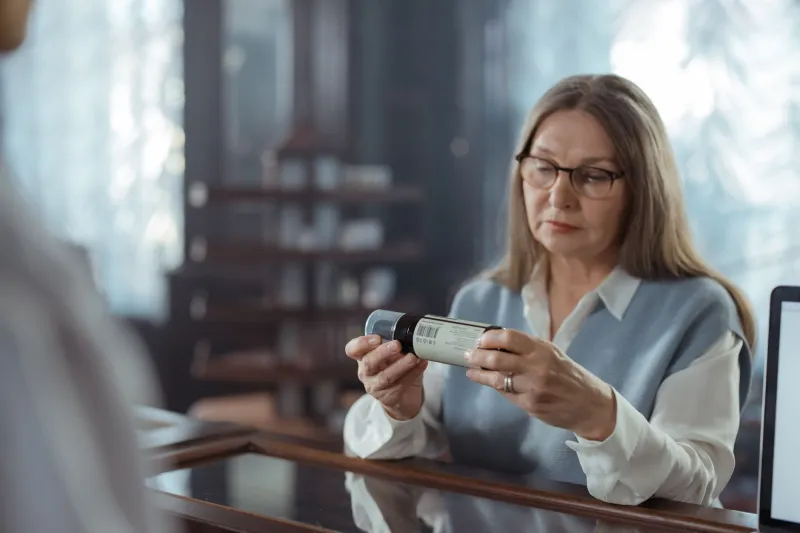
Bring the actual bottle — the label matters more than the drug name. Then work through this:
- Does the label say do not crush, split, or chew? If yes, do not.
- Is this an ER/XR/XL/SR product or an enteric-coated tablet?
- Is there a liquid, disintegrating, or sprinkle version of the same drug?
- If I can't swallow it whole, what's the plan — today, not next month?
- Does the alternative need a new prescription, prior authorization, or a different copay?
- If I'm using a feeding tube, how should this be given and flushed?
Ask once, write the answer on the bottle with a marker, and you're set for the next refill.
The Bottom Line
Struggling to swallow a pill is common, and it's not a character flaw. But some tablets genuinely cannot be broken, and the reason is engineering, not stinginess. Your pharmacist can look at the exact product in your hand and tell you what's safe — usually in under two minutes. That's a much better use of a spoon-free afternoon than guessing.