The Two-Letter Codes on Your Pill Bottle, Translated for Actual Humans

Photo: close-up prescription pill bottle label with pharmacist explaining directions at pharmacy counter, realistic stock photo, via imgv2-2-f.scribdassets.com
You’re at the pharmacy counter, card in hand, and the tech slides a bag toward you. The label reads: Take 1 tab PO BID PRN. You nod. The line moves. You get to the car and realize you’re not totally sure whether that means one tablet twice a day, one tablet twice a day only if needed, or something else entirely.
That’s not a personal failing. Prescription labels are written in a shorthand that pharmacists and prescribers use all day, and most patients are never taught it. The good news: the code is finite. You can learn the handful of abbreviations that matter, find the plain-English version hiding on the label, and confirm anything fuzzy in under a minute at the counter.
First, the Word “Sig”
On a prescription, the directions are called the sig—short for the Latin signa, meaning “write” or “label.” The prescriber writes the sig, and the pharmacy translates it into the label. Some pharmacy software prints both the abbreviation and a sentence like “Take 1 tablet by mouth twice daily.” Others print only the code because that’s what the system received.
So the tiny Latin isn’t there to be mysterious. It’s a compression format. Your job is to make sure the compressed version and the human version match in your head.
The Codes You’ll Actually See
Here’s the working vocabulary, in plain terms:
- PO — by mouth (per os). If a label says “1 tab PO,” swallow it; don’t crush it into a cream or assume it goes under the tongue.
- QD — once daily. This one is genuinely risky: QD can be misread as QID (four times daily). Many hospitals and pharmacies now avoid QD entirely and write “daily.” If you see QD, treat it as a prompt to double-check.
- BID — twice a day. TID — three times a day. QID — four times a day.
- QHS or HS — at bedtime (hora somni).
- QAM — every morning.
- QOD — every other day. Only one letter apart from QD, which is why it causes trouble.
- PRN — as needed (pro re nata). This is not a free pass to take it whenever; there should be a reason and a maximum.
- AC — before meals. PC — after meals.
- SL — under the tongue. PR — rectally. Supp — suppository.
- gtt — drops, usually for eyes or ears.
- NPO — nothing by mouth. You’ll see this in instructions around procedures, not usually on a take-home bottle.
You’ll also see quantity and duration codes: #30 means thirty units, and ×10 days means for ten days. Those matter because a label that says “take 1 tab daily” but dispenses 20 tablets is telling you something about the intended course.
Where the Plain English Is Hiding
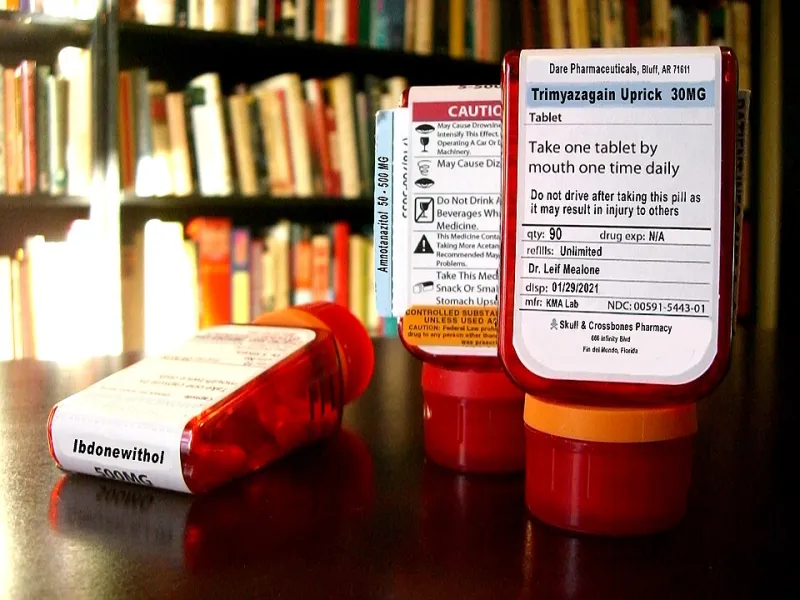
Before you panic-translate in the parking lot, look at the whole label. Most US prescription labels include a directions section that spells out the sig in sentence form, often right below the drug name and strength. There may also be auxiliary stickers—the little yellow or red flags—that say “Take with food” or “May cause drowsiness.”
The bag itself sometimes has a longer printout, and the pharmacy receipt often repeats the directions. If the bottle only shows codes, that’s your cue to ask. You are not being difficult; you’re doing exactly what the label is supposed to support.
The Codes That Cause the Most Trouble
A few patterns deserve extra attention:
QD versus QID. One tablet daily and four tablets daily are not close. If the label says QD, ask the pharmacist to say the frequency out loud. Many systems now print “once daily” for this reason.
QOD. Every other day is easy to turn into every day when you’re tired. If you see QOD, ask which days. A calendar note beats memory.
PRN without a ceiling. “Take 1 tablet by mouth every 6 hours as needed for pain” is clearer than “PRN.” But even then, ask: What’s the maximum in 24 hours? What symptom is this for? Can I take it with the other thing on my shelf? The label may not answer all three.
AC and PC. “Before meals” and “after meals” sound simple until your meals move around. Ask whether “before” means 30 minutes before or just not with food. The answer depends on the drug.
Ranges and “as directed.” “Take 1–2 tablets” and “use as directed” are common, but they put a lot of decision-making on you. Ask for the rule: when do I take one, and when do I take two?
A 60-Second Counter Check
You don’t need a system. You need a habit. Before you leave the counter, try this:
- Read the directions out loud as you understand them. “So I take one at breakfast and one at dinner?” The pharmacist can correct you immediately.
- Use teach-back. Ask: “If I take this at 8 a.m., when is my next dose?” This catches frequency errors fast.
- Check the math. If the label says twice daily for 30 days and the bottle has 30 tablets, something is off. Ask.
- For PRN, ask two questions. “What is this for?” and “What’s the most I can take in a day?”
- Ask for plain words on the bottle. Most pharmacies can add a plain-language line or a sticky note. It’s a normal request.
If someone else picks up your prescription, have them call you from the counter or ask the pharmacy to include the printed directions. A bag handed to a neighbor is not a handoff.
At Home, Make the Label Do Less Work
Once you’re home, don’t rely on the abbreviation being memorable. Write the plain version on a single medication sheet or a note on your phone: drug name, strength, what it’s for, how often, and the max daily dose. For PRN bottles, add the reason and the ceiling. For QOD drugs, put the actual days on a calendar.
If a new label replaces an old one, cross out the old directions or discard the old bottle. Two labels with different sigs on the same shelf is how doubles happen.
The Point Isn’t Latin. It’s Confirmation.
You don’t need to memorize a dead language to take your medicine correctly. You need to recognize the few codes that carry real risk, find the translated directions, and ask before you leave. Pharmacists translate sigs all day; it’s one of the most ordinary parts of the job. The only unusual thing would be guessing silently—and that’s exactly what the label is trying to prevent.